How We Set the Drone Endurance Record: 13 Hours, 4 Minutes
Apr 27, 2026
Share:
)
In March 2021, a Skyfront Perimeter 8 took off from a farm field in Silicon Valley before sunrise and didn't come down until after sunset. Thirteen hours and four minutes later, it ran out of fuel and landed. Five years on, no one has broken that drone endurance record. This is the story of how we did it, and what it means for anyone evaluating a long endurance drone today.
Why we did it
We wanted to set the world record for two reasons: First, we wanted to show people what the Perimeter 8 was actually capable of. And second, it was an internal forcing function. Going after a record meant we had to optimize for efficiency, power output, and weight across the entire airframe. That work fed back into the production aircraft making it better for future customers.
Before we committed to the record, we ran the numbers. We started with back-of-the-envelope power consumption calculations at various weights. That told us 12 hours was within reach. Then we built a simulation based on differential equations using actual measured fuel consumption and power consumption at different power outputs. The simulation turned out to be accurate to within an hour, which is honestly better than we expected.
The aircraft: a stock Perimeter 8, no mods
We are very proud of the fact that the version of the drone that broke the record was a stock Perimeter 8 hybrid drone.
Most drones that go after endurance records are stripped-down versions of the original aircraft. Weight gets pulled out anywhere it can. Redundancy gets removed. Features gets sacrificed. The vehicle is a one-off science project that has no relationship to the product the company actually sells.
But we didn't do that. That would be cheating.
The only modification we made was adding a large external auxiliary fuel tank. Underneath, it was the same eight-rotor, fuel-injected gasoline-powered drone multicopter we ship to customers. We even carried about a kilogram of additional payload over the stock configuration: two cameras and a stopwatch, so the flight could be independently verified from onboard footage and telemetry.
The flight
We took off from our flight field in Silicon Valley around 6 AM, before the sun had fully risen. The field is on farmland away from populated areas.
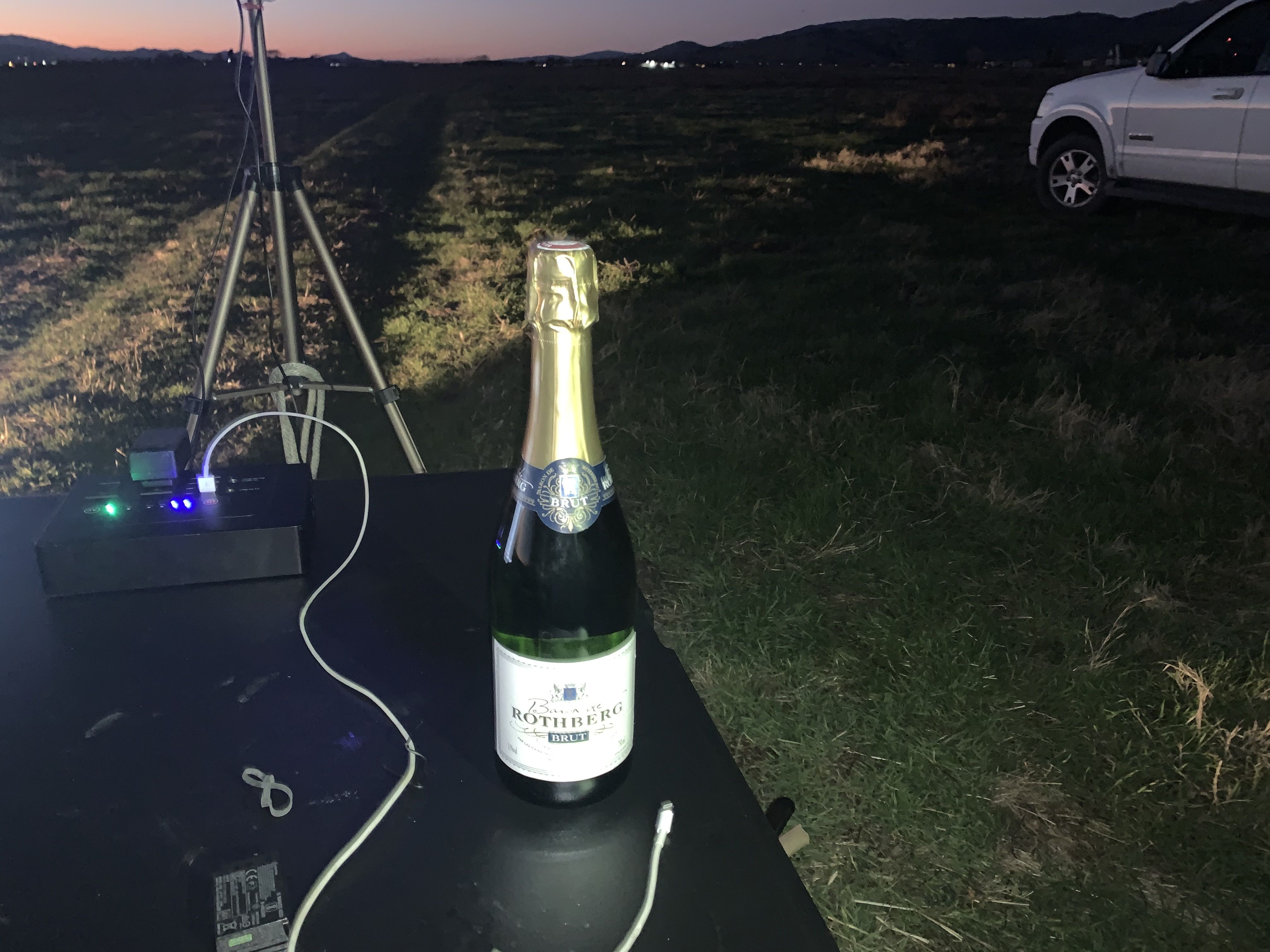
Three of us were on site: our operations lead Joseph, our pilot Nick, and me. We made an event out of it. Nick brought his camping gear. We cooked food during the flight. Joe brought a bottle of champagne just in case we set the record.
The flight itself was autonomous. Once the Perimeter 8 was on its mission profile, our job became airspace monitoring and not much else. My biggest concern was making sure no other aircraft entered the area during the flight.
For most of the day it was incredibly boring. We sent emails. We talked. We watched the drone fly in circles and we watched the sun cross the sky.
The final hour
The mood changed once we passed our 12-hour prediction.
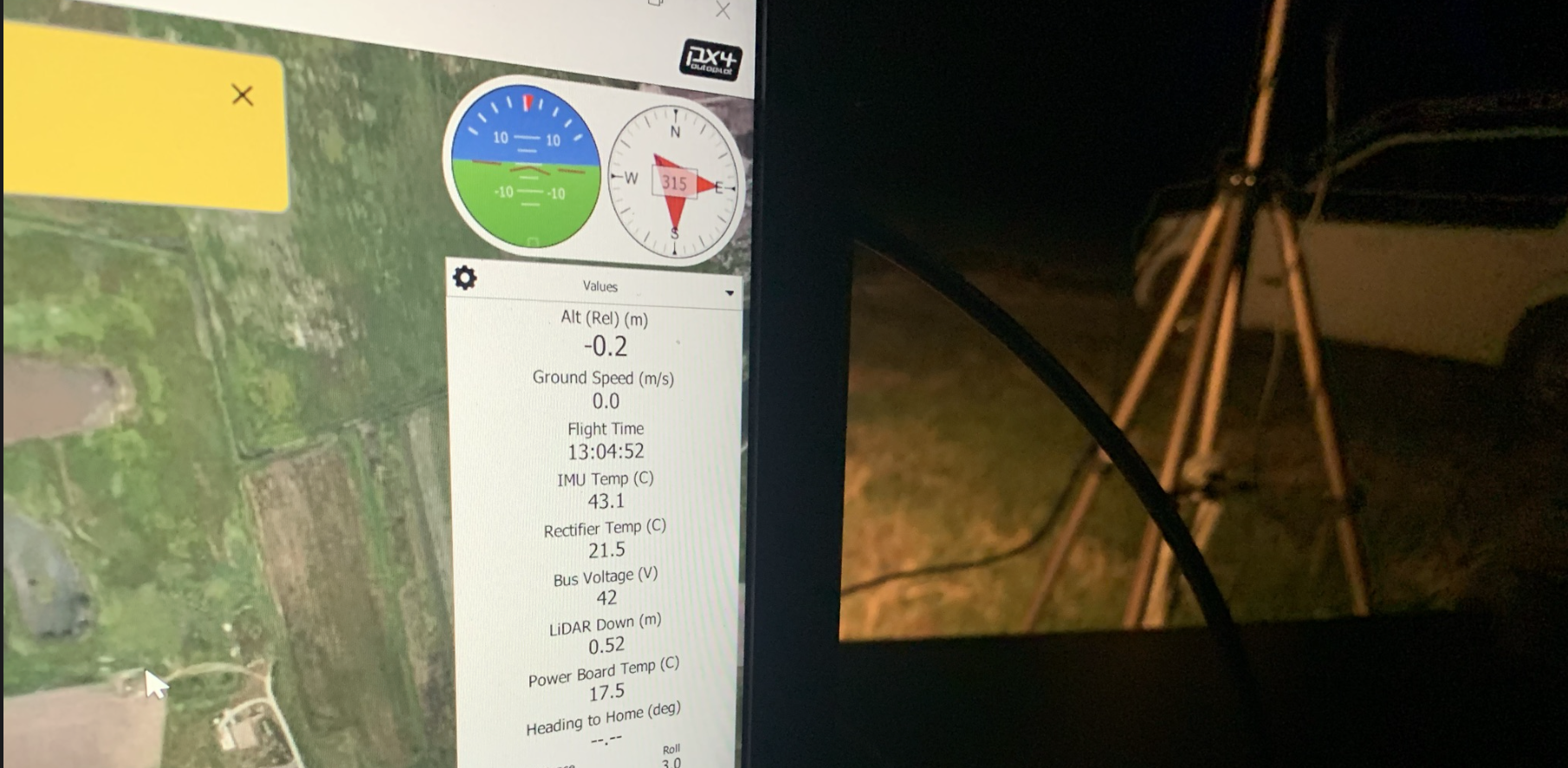
We could see from the power consumption telemetry that the airframe was getting lighter, which meant fuel was burning down. But we didn't have a precise fuel measurement on our auxiliary tanks. We knew there was fuel left but not how much.
So we sat there watching the drone, knowing it was about to run out, not knowing exactly when. It kept going. It kept going. It went a full hour past what our simulation predicted. We were genuinely shocked at how much margin we had left.
It ran out of fuel at 13 hours and 4 minutes. Before takeoff, one of our guys had said to the drone, “see you in 13 hours.” That turned out to be almost exactly right.
We had champagne after it landed. It was one of the team’s proudest moments and a culmination of all our hard work over the years. We had captured the entire arc of the sun in a single flight, from sunrise to sunset, on a stock commercial drone.
Why we never went to Guinness
People sometimes ask why we didn't pursue official Guinness World Records verification. The answer is that we didn't feel like paying for an award.
The Perimeter 8 carried two video cameras and generated continuous telemetry data throughout the flight. That was our proof. The footage shows the entire 13-hour, 4-minute flight without interruption. That evidence is more rigorous than what most certified record attempts produce, and it doesn't require a fee to a private for-profit organization to be considered legitimate.
Or customers and industry experts were thoroughly impressed. That was all the verification we needed.
Five years later, the record still stands
It has been five years. No one has broken the 13-hour, 4-minute multirotor flight time record. That’s crazy.
In the meantime, we have continued to improve the Perimeter 8. The current generation of aircraft is more efficient and more capable than the one we flew in 2021. We can actually fly longer than 13 hours with today's airframe. We just haven't gone out and done another record run, because the point of the original flight has held up: the Perimeter 8 is the longest endurance multirotor drone on the market, and the gap is large enough that no one has bothered to challenge it.
Why drone endurance is the problem that matters
Along with payload capacity, drone endurance is one of the single biggest factors that determine whether a drone is actually useful for serious commercial or military work. Short flight time is what keeps drones stuck doing toy missions.
Our entire business is about doing the things crewed helicopters do, but for far less money. Helicopters can stay airborne for hours. As soon as a drone can match that, that’s when things become interesting. Until then, you are stuck doing short range missions and swapping batteries.
We see this play out across three customer segments in particular:
In LiDAR surveying, our commercial customers don't have to think about endurance. It eliminates range anxiety. They can cover large jobs with comfortable margin and not worry about whether they will finish before the drone needs to come back.
In utility inspection, the same dynamic applies. Inspecting transmission corridors, pipelines, and substations at scale is a job that battery drones simply cannot complete in a reasonable number of flights.
In ISR, particularly for defense and public safety customers, persistent overhead presence is the entire mission. A long endurance drone delivers it. A battery drone delivers a short loiter and then disappears for an hour to recharge.
When customers ask whether they really need a long endurance drone, the answer is yes if they are competing with crewed aircraft services. And that is where most of the commercial and military market actually lives. Short-range jobs are not where the true potential is.
The takeaway
The 13-hour, 4-minute flight was a public demonstration that hybrid-electric multicopters had crossed the threshold from interesting prototypes to serious competitor to commercial aircraft. A stock production drone, with extra payload onboard, flew longer than any multirotor ever has. And five years later, it still has.


 Location
Redwood City, CA 94063, USA.